
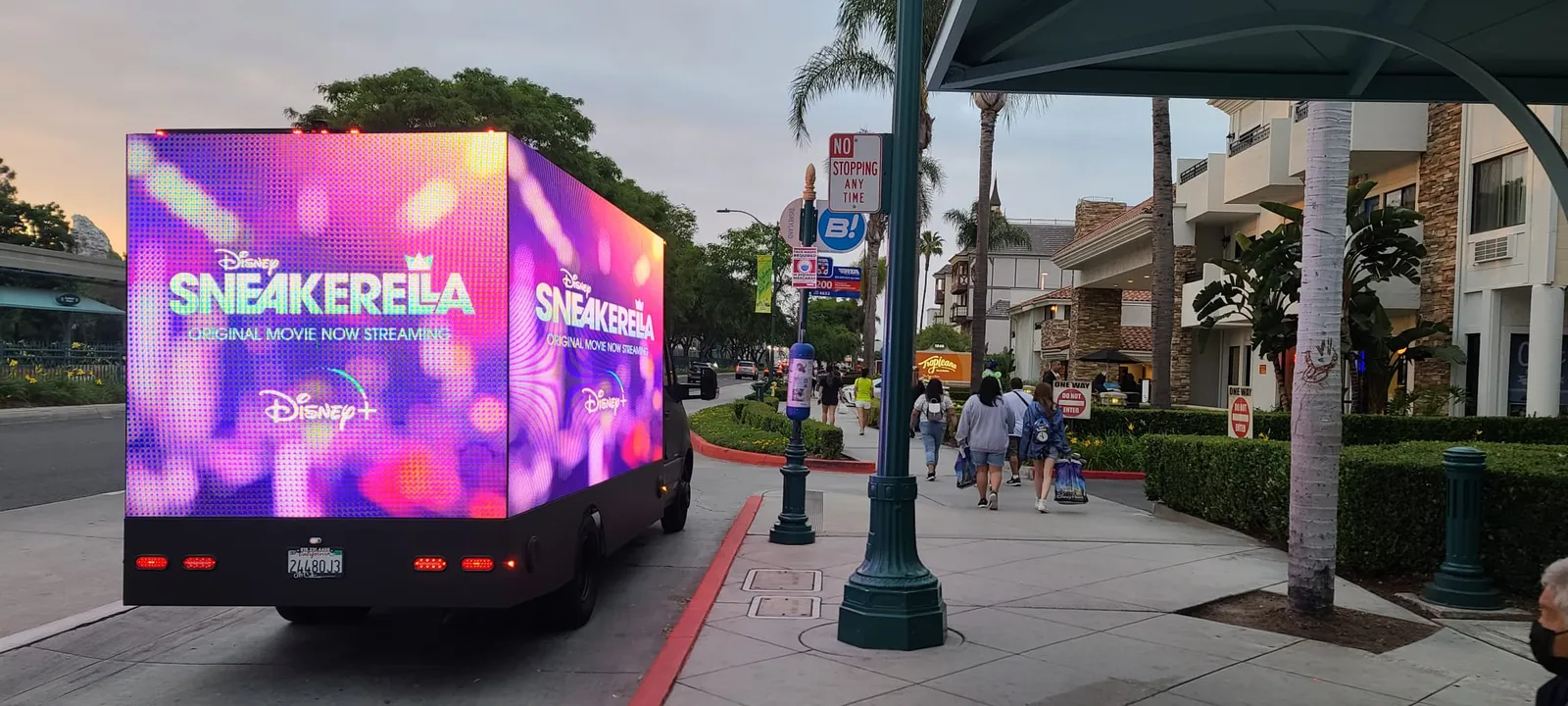
Most comparisons of these two formats are written by someone selling one of them. This one is too, so treat the conclusion accordingly — but the honest version is that static billboards are better at some jobs and there is no point pretending otherwise.
The decision comes down to four variables: how long you need presence, how precisely you need to target, how fast the message might change, and whether the campaign has a date attached.
Where static billboards win
Sustained presence at a fixed location over many months is cheaper on a static board, and that is not close. If you are a regional business that wants to own one high-traffic intersection year-round, buy the board. The cost per month of permanent visibility is far lower than running a truck continuously.
Static also wins on pure unattended hours. A board works at 3am on an empty highway; a truck does not, because it is not out there. If your objective is ambient, always-on presence, fixed inventory is the correct tool.
Where mobile wins
- Campaigns with a fixed date — launches, events, openings, elections
- Precise geographic targeting at neighborhood or corridor level
- Messages that need to change mid-flight, same day
- Markets where fixed inventory is sold out or prohibitively expensive
- Event and convention audiences concentrated in a known place at a known time
- Short flights where a long-cycle booking is impractical
The targeting difference
A static billboard reaches whoever passes one point. That is a demographic you inherit rather than choose. A mobile route reaches a geography you selected — a trade area, a commuter corridor, a voting district, a five-mile radius around a new location.
For campaigns where the audience is defined by where they are rather than by broad demographics, this is not a marginal improvement. It is a different product.
On the recall statistics
You will see figures quoted in this category — commonly cited out-of-home research puts mobile billboard ad recall around 97% against roughly 58% for online advertising, and attention at several times that of static signage. These figures come from industry studies rather than from our own measurement, and like most vendor-cited research they should be read as directional rather than precise.
The mechanism behind them is more useful than the numbers: a large, moving, illuminated screen at eye level in physical space is harder to ignore than a static panel you have driven past two hundred times, and impossible to ad-block. That is the real argument, and it does not depend on a particular percentage being exactly right.
The lead-time difference
Static out-of-home requires production and installation, and inventory is booked in cycles. Mobile campaigns launch within 24–48 hours of creative approval because there is no printing step.
For anything reactive — a competitor’s announcement, a news cycle, a sudden opportunity — that gap is the entire decision.
Related pages
Want this run in your market?
If trucks are available, your campaign is live in 24–48 hours.
More reading
The Complete Guide to Mobile LED Billboard Truck Advertising in 2026
How mobile LED billboard advertising actually works — hardware, routing, pricing, measurement and when it beats static out-of-home.
Read more → PoliticalHow Political Campaigns Use LED Billboard Trucks
District-level targeting, same-day message changes and rapid response — why mobile LED fits the political calendar better than booked media.
Read more → EventsConvention & Trade Show Advertising: How to Stand Out at CES, SXSW and Beyond
Why conquesting the street outside a trade show works, where to route during a show, and how to time creative to the session schedule.
Read more →