
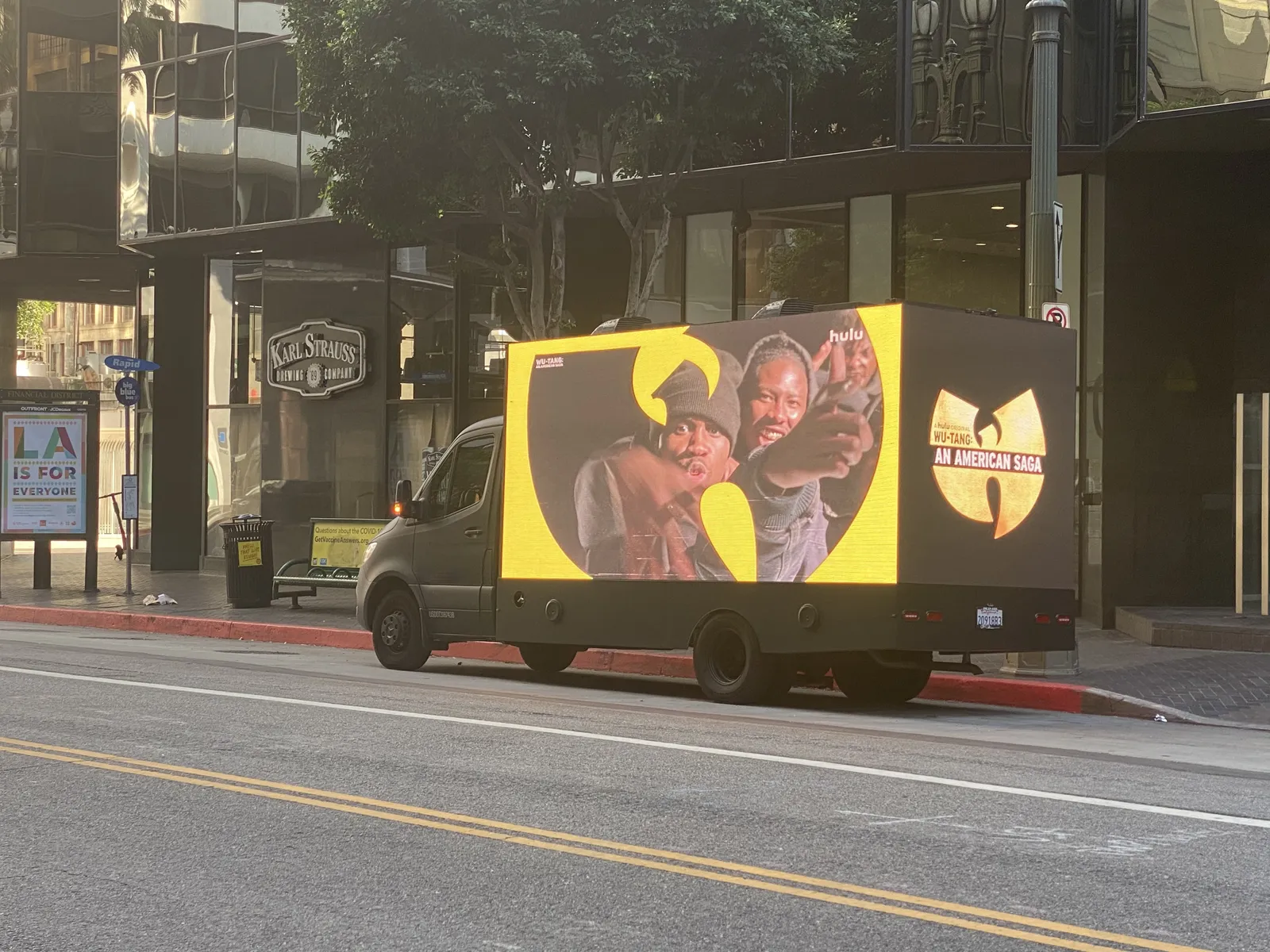
Political advertising has a structural problem that mobile LED addresses directly: the message changes faster than the media buy. A broadcast or print flight committed three weeks ago cannot respond to an opponent’s ad, a news cycle, or a committee vote that moved. Mobile can, within hours, at no additional cost.
That responsiveness, plus targeting at district and precinct resolution, is the entire case for the format in this category.
Geographic precision
Campaigns are won in specific places. A congressional district, a handful of swing precincts, the blocks around a legislative building — these are the units that matter, and most media does not target at that resolution. Broadcast buys a metro. Mobile buys a route.
Routing is planned street by street, which means a campaign can concentrate entirely inside a target district and the GPS log will prove it did. For a down-ballot race or a local ballot measure, that difference between metro-wide waste and district-level concentration is the whole budget.
Rapid response
The single most valuable property of the format in politics is the speed of the creative loop. New artwork is approved and live on the route the same afternoon, remotely, through a cloud platform. When a story breaks at 10am, a response can be on the street by mid-afternoon.
No other out-of-home format does this. Printed inventory requires production and installation; even digital fixed boards are typically sold through a booking process measured in days.
Where campaigns route
- Commuter corridors — the highest-frequency contact with working voters, twice daily, inside a defined geography
- Capitol and legislative districts — Sacramento, Washington DC, Austin and state capitols during session
- Rallies and events — perimeter routing where supporters and press are already gathered
- Targeted precincts — neighborhood-level routing for turnout and persuasion
- Early-vote and polling locations — subject to jurisdiction-specific distance and conduct rules
The legislative advocacy case
Advocacy is a different problem from a campaign. The audience is not a population, it is a few hundred specific people — legislators, staff, committee members, agency officials — who work within walking distance of each other in Sacramento, Washington DC, or a state capitol.
Because that audience is so geographically concentrated and works on a published schedule, routing can be timed to hearings, floor votes and comment deadlines rather than to clock hours. When the calendar moves, which it constantly does, the route and creative move with it.
Compliance, honestly
Two things are worth being clear about. First, disclaimer and disclosure requirements vary by jurisdiction and by race, and the content of that disclaimer is the campaign’s responsibility and its counsel’s — a vendor should make sure it displays legibly, not advise you on what it should say.
Second, the rules governing electioneering near polling places differ by state and change between cycles. Any vendor who tells you flatly what you can do near a polling location without checking the current jurisdiction rules is guessing. The correct answer is that the rules get confirmed for each deployment.
What the format does provide for compliance purposes is a GPS record of exactly where and when each message ran, which is often useful for reporting.
Related pages
Want this run in your market?
If trucks are available, your campaign is live in 24–48 hours.
More reading
The Complete Guide to Mobile LED Billboard Truck Advertising in 2026
How mobile LED billboard advertising actually works — hardware, routing, pricing, measurement and when it beats static out-of-home.
Read more → EventsConvention & Trade Show Advertising: How to Stand Out at CES, SXSW and Beyond
Why conquesting the street outside a trade show works, where to route during a show, and how to time creative to the session schedule.
Read more → MarketsLED Truck Advertising in New York City: Routes, Costs and Best Practices
How mobile billboard campaigns work in Manhattan and the outer boroughs — the corridors that matter, what it costs, and the constraints to plan around.
Read more →