
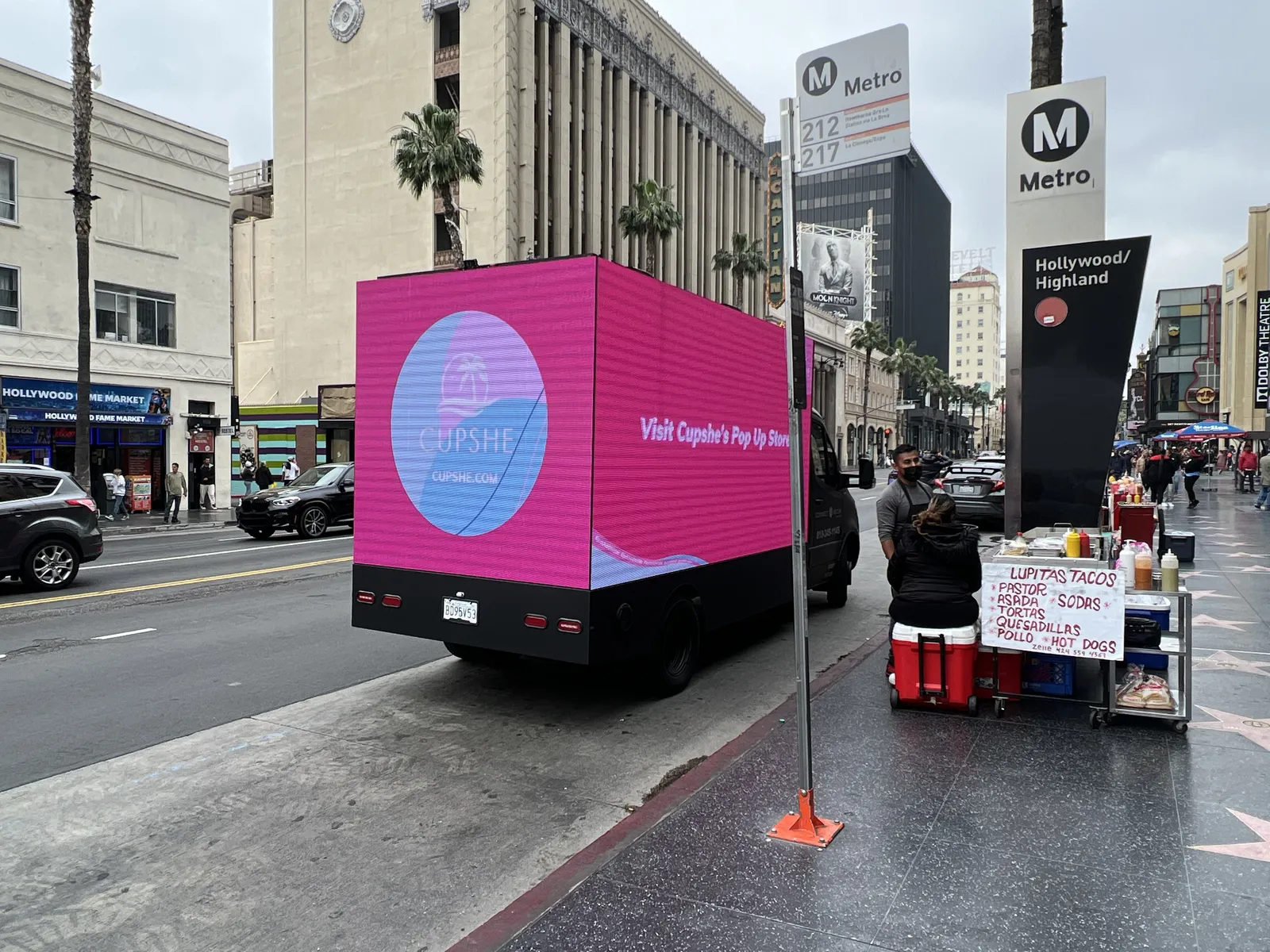
A mobile LED billboard is a full-size truck carrying a high-brightness digital screen that drives a planned route instead of standing at a fixed intersection. That single difference — the route — changes nearly everything about how the medium is bought, targeted and measured, and it is why the format behaves less like traditional out-of-home and more like a media plan.
This guide covers the parts that actually matter when you are deciding whether to run one: the hardware specification, how routes get built, what campaigns cost, how delivery is verified, and where the format is a poor fit.
The hardware, and why the specification matters
The two numbers that determine whether a mobile billboard works are brightness and screen area. Brightness is measured in NITs, and it decides whether the screen is readable at noon or only after sunset. A screen in the 2,500–5,000 NIT range washes out in direct sun; 10,000 NIT is the class built to stay legible in full daylight. If a vendor will not tell you the NIT rating, that is the answer.
Screen area decides legibility at distance. Our panels run up to 9′ × 21′ — more than 180 square feet per side — typically in 3-sided configurations so the creative reads from both sides of the street and from behind in stopped traffic. Full HD resolution and full-motion video are the baseline; a mobile screen that can only show static images is a static billboard with a fuel bill.
How routing works
Routing is the actual product. A campaign starts from the audience — who they are, where they live and work, when they are on the road — and that produces a target geography and a set of dayparts, which produces a route.
The optimization from there is about dwell time rather than distance. Congestion that frustrates drivers is what makes the format work: a truck moving at 12 mph past stopped cars is being read, not glanced at. A route that covers more miles on an empty highway delivers less than a shorter route through a corridor that backs up at 5pm.
What it costs
Typical campaigns run $1,500 to $5,000+ per day, with the range driven by market, duration, number of trucks and how much geography you want covered. Longer flights price better per day than single-day activations, and geographically large markets like Los Angeles, Dallas and Houston often need multiple trucks to achieve meaningful coverage where a compact market like San Francisco or Sacramento does not.
The variable most people underestimate is timing. Peak windows — CES week in Las Vegas, Comic-Con in San Diego, SXSW in Austin, Art Basel in Miami — are the highest-demand periods in their markets and sell out well in advance.
Measurement and verification
A single truck generates 30,000–70,000+ impressions per day in high-traffic urban areas, with the top of that range reached where pedestrian density is highest — the Las Vegas Strip, Manhattan, Lower Broadway in Nashville.
Impressions matter less than verification. Every truck logs GPS position and timestamps continuously, producing a record of exactly which streets were covered, in what order, at what time. That feeds a live dashboard during the campaign, not just a report afterward, which means an underperforming route can be changed while the campaign is still running. Proof-of-performance photos and video come as standard.
Where the format is genuinely better
- Campaigns with a date attached — launches, events, openings, elections
- Markets where fixed inventory is sold out, unaffordable, or both
- Targets defined by geography rather than demography
- Messages that need to change mid-flight
- Event and convention audiences concentrated in a known place at a known time
Where it is not the right tool
Mobile LED is a poor fit for campaigns that need sustained, permanent presence at a single location over many months — a fixed billboard is cheaper for that, and it is the honest answer. It is also weak where the target audience is genuinely national and dispersed rather than concentrated in cities, and it cannot reach people who are not out of the house.
The format is bought in days and weeks. If your planning cycle is quarters and your objective is ambient brand presence, traditional out-of-home will serve you better.
Timeline to launch
When trucks are available, a campaign launches within 24–48 hours of creative approval, including route planning and scheduling. Bring finished assets or have creative produced for LED — either way, there is no printing step, which is the lead time that makes traditional out-of-home slow.
Related pages
Want this run in your market?
If trucks are available, your campaign is live in 24–48 hours.
More reading
How Political Campaigns Use LED Billboard Trucks
District-level targeting, same-day message changes and rapid response — why mobile LED fits the political calendar better than booked media.
Read more → EventsConvention & Trade Show Advertising: How to Stand Out at CES, SXSW and Beyond
Why conquesting the street outside a trade show works, where to route during a show, and how to time creative to the session schedule.
Read more → MarketsLED Truck Advertising in New York City: Routes, Costs and Best Practices
How mobile billboard campaigns work in Manhattan and the outer boroughs — the corridors that matter, what it costs, and the constraints to plan around.
Read more →