
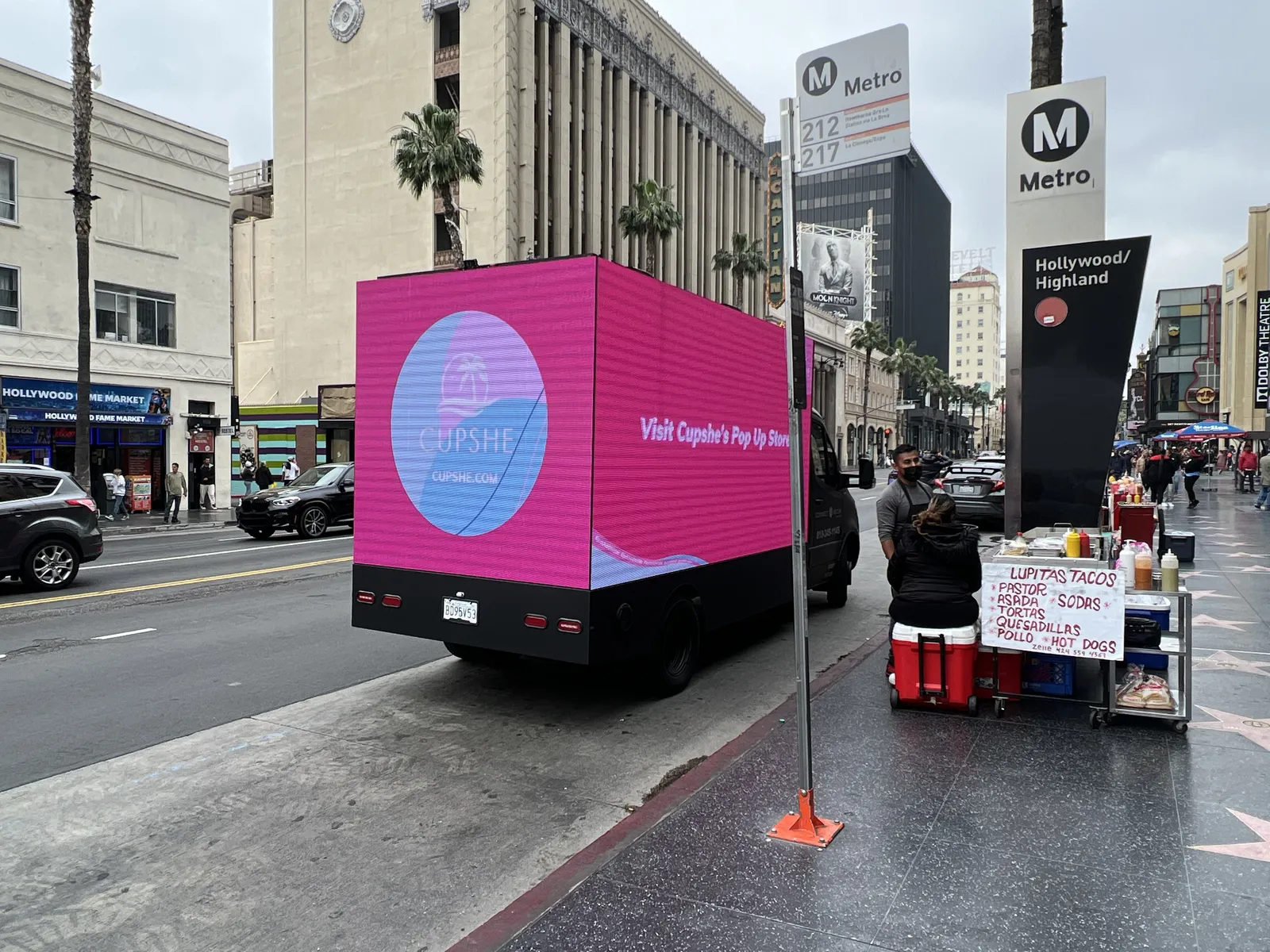
In most markets a mobile LED truck reaches people in cars. In Manhattan it reaches people on foot, standing close enough to read a full sentence of copy. That difference should change how you plan the campaign and how you design the creative.
Midtown crosstown traffic moves slowly enough that a truck becomes effectively a fixed display for minutes at a time — in front of a crowd that completely changes over while it sits there. Reach and frequency both climb at once, which is rare.
The corridors that matter
- Broadway — the island’s diagonal spine, from the Theater District south through SoHo
- Fifth and Sixth Avenues — the north–south pair carrying Midtown retail and office volume
- 42nd Street — crosstown from the UN to the Javits Center via Times Square
- West Side Highway — high-volume routing along the Hudson past Hudson Yards
- Canal Street — the crosstown route feeding the Holland Tunnel
- Flatbush Avenue — Brooklyn’s main artery past Barclays Center
Costs, and the comparison that matters
Typical New York campaigns run $1,500 to $5,000+ per day. The number that makes that look reasonable is the comparison: fixed Manhattan inventory is the most expensive out-of-home in the world, the best of it is locked into long-term contracts, and it is sold in cycles rather than by the week.
For a launch, a Fashion Week activation or a holiday retail push, a routed truck buys the window you actually need without a year-long commitment or a six-figure floor.
The windows worth targeting
Fashion Week in February and September concentrates an industry audience into specific venues and after-party corridors on a known schedule. The November–December retail run puts the largest pedestrian volumes of the year on Fifth Avenue and in SoHo.
Javits Center shows bring convention traffic to the far West Side, where the hotel and rideshare corridors are unusually well-defined. And the city’s density of press and agencies means a physical presence in a few specific neighborhoods does work for launches that a national digital buy does not.
Constraints to plan around
New York is the market with the most route constraints in our footprint. Some Manhattan streets carry vehicle restrictions, and event-day closures are frequent and sometimes announced late. This changes routing rather than preventing it — perimeter routes around a closure often carry the heaviest foot traffic — but it means route plans here need more flexibility than elsewhere.
The practical implication: confirm current requirements before every deployment rather than assuming last year’s route still works.
Creative advice specific to NYC
Because the audience is on foot and close, New York tolerates more copy than any other market. Elsewhere the rule is six words and a logo, read at 40 mph from three lanes away. In Midtown, a pedestrian standing at a crosswalk for 45 seconds can read considerably more — and a QR code at that distance actually scans.
Related pages
Want this run in your market?
If trucks are available, your campaign is live in 24–48 hours.
More reading
The Complete Guide to Mobile LED Billboard Truck Advertising in 2026
How mobile LED billboard advertising actually works — hardware, routing, pricing, measurement and when it beats static out-of-home.
Read more → PoliticalHow Political Campaigns Use LED Billboard Trucks
District-level targeting, same-day message changes and rapid response — why mobile LED fits the political calendar better than booked media.
Read more → EventsConvention & Trade Show Advertising: How to Stand Out at CES, SXSW and Beyond
Why conquesting the street outside a trade show works, where to route during a show, and how to time creative to the session schedule.
Read more →