
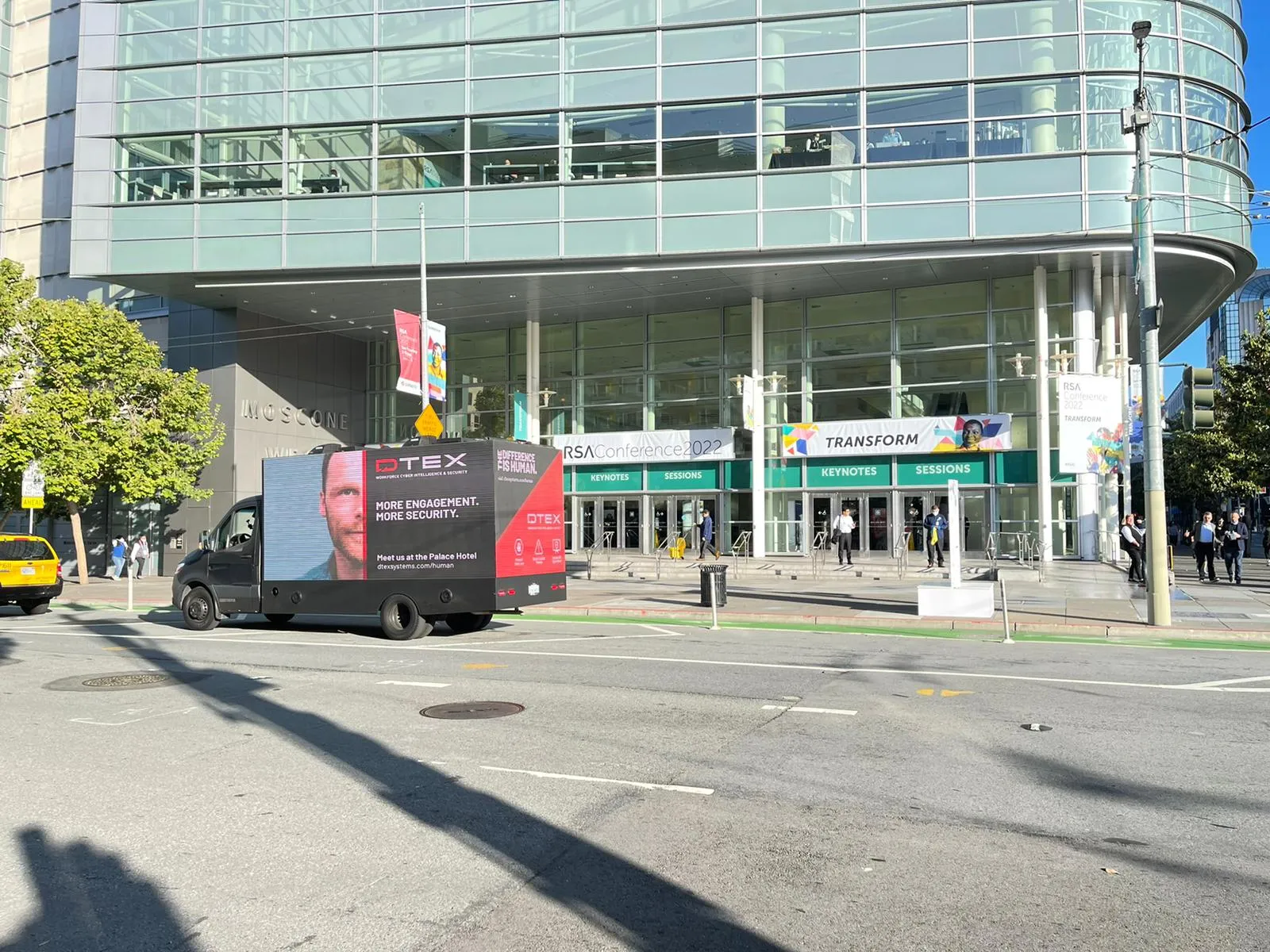
Las Vegas is a convention city first and a tourism city second, and both audiences favor this format. Visitors arrive with no fixed routine, walking corridors they do not know, actively reading their surroundings. Attention that other markets have to earn is simply available here.
The practical consequence is that Strip routing sits at the top of our 30,000–70,000+ daily impression range, because the audience is on foot and at eye level rather than behind glass at 45 mph.
Convention conquesting is the strongest play
When a trade show fills a venue with your customers and your competitors for four days, the sidewalk, the shuttle queue, the rideshare zone and the hotel approach are the only places the show floor does not control. You do not need to be an exhibitor to advertise there.
Route the convention campus during show hours, timed to session breaks rather than clock hours, and extend to host hotels and the evening dinner corridors. Attendees spend more unstructured time outside the hall than most exhibitors realize.
The corridors
- Las Vegas Boulevard — the Strip itself, slow traffic beside continuous sidewalk crowds
- Paradise Road — the convention-to-airport artery parallel to the Strip
- Koval Lane — back-of-house hotel access and rideshare staging behind the east Strip
- Flamingo and Tropicana — the cross-Strip connectors funneling resort traffic
- Fremont Street approach — a second, younger, later-running nightlife district
- Harry Reid airport approach — reaching arrivals before they reach a hotel
The booking calendar
Vegas runs on a convention calendar, not a seasonal one. CES in January, SEMA in November and the Formula 1 Grand Prix are the three hardest windows to book and the three most valuable to own. Championship fight weekends and Sphere residencies add further peaks.
Standard lead time to launch is 24–48 hours from creative approval, but that assumes availability — and during CES it frequently does not exist at any price. Book marquee weeks months ahead.
Dayparting the Strip
Convention dayparts run 8:00–10:00am and 4:00–6:00pm around venue entrances and rideshare zones. Strip pedestrian volume builds from mid-afternoon and peaks 8:00pm to midnight. Fremont Street runs later and younger.
Because creative updates remotely at no cost, the same truck can carry a B2B convention message during show hours and a consumer message on the Strip at night. In a market with two entirely different audiences sharing one corridor, that is the obvious move.
Related pages
Want this run in your market?
If trucks are available, your campaign is live in 24–48 hours.
More reading
The Complete Guide to Mobile LED Billboard Truck Advertising in 2026
How mobile LED billboard advertising actually works — hardware, routing, pricing, measurement and when it beats static out-of-home.
Read more → PoliticalHow Political Campaigns Use LED Billboard Trucks
District-level targeting, same-day message changes and rapid response — why mobile LED fits the political calendar better than booked media.
Read more → EventsConvention & Trade Show Advertising: How to Stand Out at CES, SXSW and Beyond
Why conquesting the street outside a trade show works, where to route during a show, and how to time creative to the session schedule.
Read more →