
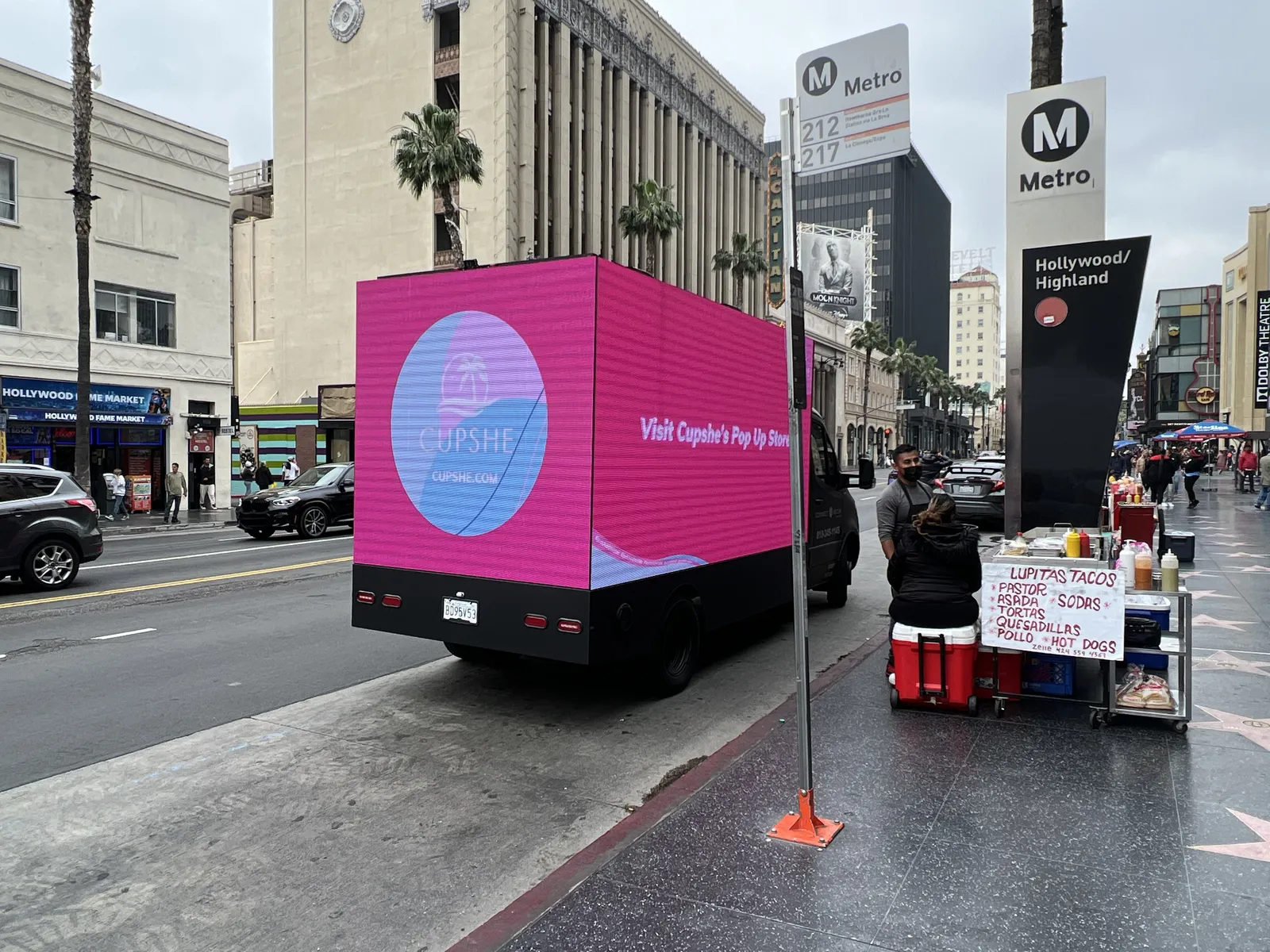
Los Angeles is the best mobile LED market in the country for a simple reason: nobody walks and everybody drives, and they drive for a long time. Traffic that residents experience as a daily frustration is, for this format, extended exposure to a captive audience.
The complication is geography. LA has no single center — it has a dozen, spread across 4,700 square miles. A campaign that tries to cover all of them covers none of them well.
The corridors that deliver
- Sunset Boulevard — the entertainment industry’s main street, Silver Lake through the Strip to the Westside
- Wilshire Boulevard — sixteen miles linking Downtown, Koreatown, Miracle Mile and Santa Monica
- US-101 / Hollywood Freeway — Valley-to-Hollywood volume with long stop-and-go dwell
- I-405 through the Sepulveda Pass — one of the highest-volume freeway segments in the country
- Ventura Boulevard — the Valley’s continuous retail spine
- Figueroa and LA Live — arena and stadium approach on event nights
Dayparting is the whole game here
LA rewards dayparting more than any market we operate in, because its neighborhoods have genuinely different audiences at different hours. The same truck can work the 101 during the morning crawl, shift to a shopping district at midday, and finish on a nightlife route after 9pm.
Creative changes remotely at no additional cost, which means those three dayparts can carry three different messages. A campaign that runs one creative all day in Los Angeles is leaving most of the format’s advantage unused.
The entertainment calendar
Awards season between January and March is the densest window of the LA year, when studio campaigns, talent promotion and for-your-consideration messaging all compete across the same few miles of Hollywood, Beverly Hills and Century City. Trucks book out early for those weekends.
Outside awards season, premieres and streaming launches run year-round in Hollywood and Westwood. These are the campaigns the format suits best: a narrow window, a specific few square miles, and a message that needs to change the moment a title goes live.
Practical timing
Morning drive runs 7:00–10:00am and holds usable congestion on the 101 and 405 well past 9am. Evening drive stretches 3:30–7:30pm, longer than in most US markets. Beach and Westside weekend volume peaks between 11am and 6pm, and nightlife routing on the Strip and Downtown works Thursday through Saturday until close.
Because the metro is so large, multi-truck buys are common here in a way they are not in compact markets like San Francisco.
Related pages
Want this run in your market?
If trucks are available, your campaign is live in 24–48 hours.
More reading
The Complete Guide to Mobile LED Billboard Truck Advertising in 2026
How mobile LED billboard advertising actually works — hardware, routing, pricing, measurement and when it beats static out-of-home.
Read more → PoliticalHow Political Campaigns Use LED Billboard Trucks
District-level targeting, same-day message changes and rapid response — why mobile LED fits the political calendar better than booked media.
Read more → EventsConvention & Trade Show Advertising: How to Stand Out at CES, SXSW and Beyond
Why conquesting the street outside a trade show works, where to route during a show, and how to time creative to the session schedule.
Read more →